
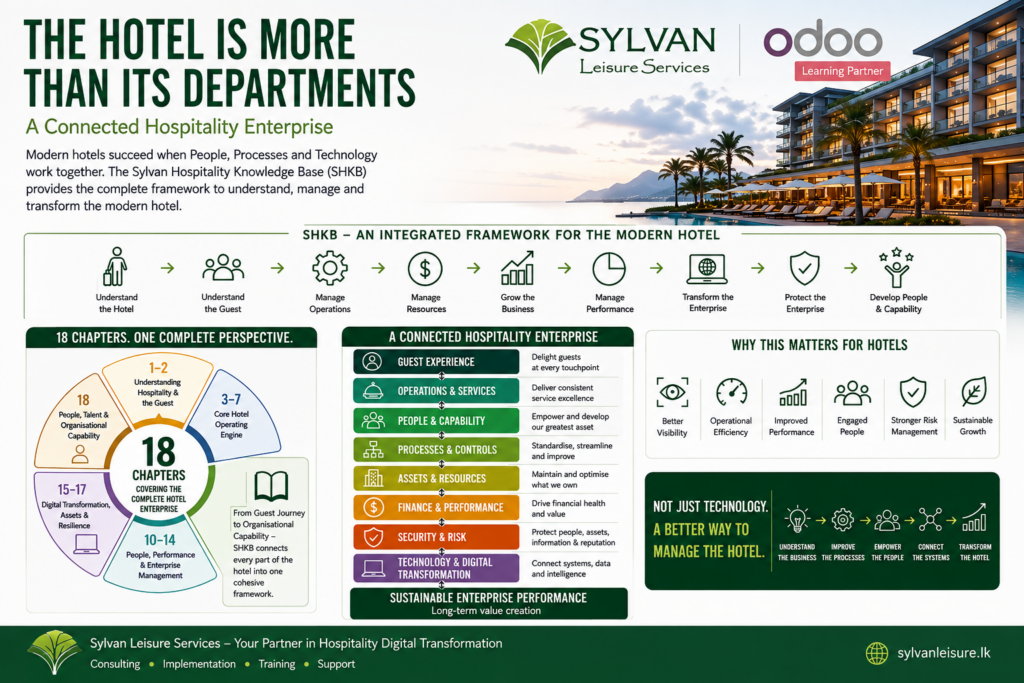
Why Hoteliers Need More Than Technology to Build a Better-Managed Hotel
The hospitality industry is changing rapidly.
Guests are becoming more digitally connected. Expectations are rising. Online reviews can influence purchasing decisions within minutes. Distribution channels are becoming increasingly complex. Labour challenges are affecting service delivery. Operating costs continue to demand tighter control. At the same time, hotel owners and managers are being asked to make better decisions using more data, more technology and fewer resources.
Against this background, one question becomes increasingly important:
Do hotels really need more technology — or do they need a better understanding of how the entire hotel works?
At Sylvan Leisure Services, we believe the answer is both.
Technology can transform hospitality operations, but technology alone does not create a successful hotel.
A hotel needs the right people, processes, systems, controls, leadership, information and culture working together.
This is the thinking behind the Sylvan Hospitality Knowledge Base (SHKB).
What is the Sylvan Hospitality Knowledge Base?
The Sylvan Hospitality Knowledge Base — SHKB is being developed as a structured hospitality management and consulting framework designed to bring together the knowledge required to understand, operate, manage and digitally transform a modern hospitality enterprise.
Rather than looking at a hotel as a collection of independent departments, SHKB looks at the hotel as an integrated enterprise.
A guest does not experience:
Reservations → Front Office → Housekeeping → Restaurant → Finance → HR → IT
as separate departments.
The guest experiences one hotel.
The same principle applies to management.
A reservation affects Front Office.
Front Office affects Housekeeping.
Housekeeping affects room availability.
Room availability affects Revenue Management.
Revenue affects Finance.
Guest experience affects Reviews and Reputation.
Reputation affects Marketing and Sales.
Employees influence every stage of the journey.
Technology connects all of these activities.
Therefore, effective hotel management requires an understanding of how all these elements interact.
That is the foundation of SHKB.
From the Guest to the Enterprise
The SHKB Volume I framework is structured around a simple progression:
Understand the Hotel → Understand the Guest → Manage Operations → Manage Resources → Grow the Business → Manage Performance → Transform the Enterprise → Protect the Enterprise → Develop People → Build Organisational Capability
This creates a complete management perspective rather than a narrow departmental one.
The current SHKB Volume I contains 18 chapters, organised into six major parts.
Part I — Understanding Hospitality & the Guest
Chapter 1 — Understanding the Modern Hospitality Business
The journey begins by understanding what a modern hospitality business actually is.
A hotel is not simply a building containing bedrooms.
It is a complex enterprise involving accommodation, food and beverage, guest services, sales and marketing, finance, human resources, procurement, engineering, security, technology and leadership.
Chapter 1 establishes this foundation and introduces the concept of the integrated hotel enterprise.
Chapter 2 — The Complete Guest Journey
The second chapter shifts the focus from the hotel to the guest.
From the moment a potential guest begins dreaming about a trip, through research, enquiry, booking, arrival, stay, departure, review and eventual loyalty, the guest moves through a series of interconnected touchpoints.
SHKB treats the Guest Journey as one of the central frameworks for understanding hospitality.
The key principle is simple:
Guests experience one hotel — not separate departments.
This perspective becomes important when analysing processes, technology, service quality and opportunities for digital transformation.
Part II — The Core Hotel Operating Engine
Once the hotel and guest have been understood, SHKB moves into the operational engine of the hotel.
Chapter 3 — Reservations, Distribution & Revenue Management
How does the hotel generate and manage demand?
This chapter examines reservations, room inventory, distribution channels, OTAs, direct bookings, channel management, pricing, demand forecasting, yield management and revenue performance.
It also considers how these processes can be supported through integrated digital systems.
Chapter 4 — Front Office Operations & Guest Services
The Front Office sits at one of the most important points in the guest journey.
This chapter examines reservations, arrivals, check-in, room assignment, guest services, guest communication, complaints, service recovery, guest folios, payments and check-out.
It then moves beyond theory into discovery, audit, process mapping, gap analysis and implementation planning.
Chapter 5 — Housekeeping Operations & Room Management
A room cannot be sold simply because it exists.
It must be clean, inspected, maintained and ready.
This chapter examines room cleaning, room status, inspections, linen, laundry, amenities, public areas, lost and found, inventory and housekeeping performance — together with the digital workflows needed to manage them effectively.
Chapter 6 — Food & Beverage Operations Management
Food and beverage represents both an important guest-experience function and a major revenue centre.
The chapter examines restaurant operations, bars, room service, banquets, kitchen operations, menu management, recipes, food costing, inventory, food safety, waste, revenue management and F&B performance.
Chapter 7 — Procurement & Supply Chain Management
Hotels consume enormous quantities of goods and services.
Procurement therefore directly affects cost, quality, availability and operational continuity.
This chapter follows the supply chain from purchasing and supplier management through receiving, warehousing, inventory, logistics, procurement controls and sustainable procurement.
Part III — Ancillary Revenue & Commercial Growth
The modern hotel does not generate value only from bedrooms.
Chapter 8 — Spa, Wellness & Recreation Management
Spa, wellness, fitness and recreation can become significant revenue centres while also strengthening the overall guest experience.
SHKB examines treatments, therapists, reservations, memberships, retail, capacity, revenue, quality, safety, sustainability and digital integration.
Chapter 9 — Hospitality Sales, Marketing & Business Development
A hotel must not only operate efficiently.
It must also create demand.
This chapter examines market segmentation, positioning, sales, corporate business, travel trade, partnerships, CRM, digital marketing, content, social media, direct bookings, loyalty and commercial analytics.
The emphasis is on connecting sales, marketing, customer data and operational delivery.
Part IV — People, Performance & Enterprise Management
A hotel cannot be managed effectively without understanding the resources that support it.
Chapter 10 — Human Resources & Talent Management
Hospitality is fundamentally a people business.
This chapter examines workforce planning, recruitment, onboarding, learning, performance, engagement, retention, succession planning, workforce analytics and strategic HR.
It also explores how digital HR capabilities can support the employee lifecycle.
Chapter 11 — Guest Experience, Reputation Management & Loyalty Programmes
The guest experience does not end at check-out.
Reviews, feedback, complaints, service recovery, reputation and loyalty all influence future demand.
This chapter brings these elements together into a structured guest-experience management framework.
Chapter 12 — Hospitality Finance, Internal Control & Audit
Revenue without control does not necessarily create a healthy business.
This chapter examines hospitality accounting, budgeting, costs, cash flow, internal controls, revenue controls, procurement controls, inventory controls, fraud prevention, audit and financial performance.
Chapter 13 — Hospitality Competitor Analysis & Market Intelligence
Hotels do not operate in isolation.
Understanding competitors, market conditions, customer behaviour, pricing, demand and emerging trends is essential for informed decision-making.
This chapter provides the framework for developing hospitality market intelligence.
Chapter 14 — Executive Leadership, Governance & Hotel Business Management
Someone must connect all of the pieces.
Chapter 14 focuses on executive leadership, governance, strategic planning, budgeting, decision-making, KPIs, risk, business continuity and executive performance management.
Part V — Digital Transformation, Assets & Resilience
This is where the SHKB framework moves from traditional hotel management into the modern digital enterprise.
Chapter 15 — Hospitality Digital Transformation & ERP Implementation
Digital transformation is not simply about installing software.
It involves understanding processes, identifying inefficiencies, standardising workflows, improving information flows, managing data, redesigning processes and helping people adopt new ways of working.
The chapter therefore examines:
- Digital maturity
- ERP
- Enterprise architecture
- Master data
- Process discovery
- Process mapping
- Workflow automation
- Business process redesign
- Data migration
- Testing
- Training
- Change management
- Digital transformation roadmaps
And importantly, it considers how Odoo 19 Enterprise can become part of an integrated hospitality technology architecture.
Chapter 16 — Engineering, Maintenance & Asset Management
A hotel’s physical assets are fundamental to its ability to deliver service.
Rooms, buildings, equipment, utilities, kitchens, pools, HVAC systems and other assets require planned maintenance and lifecycle management.
This chapter examines preventive, corrective and predictive maintenance, asset management, utilities, sustainability, engineering risk and maintenance performance.
Chapter 17 — Security, Risk Management & Loss Prevention
A successful hotel must also protect what it has built.
Security is not limited to guards and CCTV.
It includes people, property, information, revenue, reputation, operations and business continuity.
Chapter 17 therefore examines physical security, incidents, loss prevention, fraud, risk assessment, crisis management, cybersecurity and continuity planning.
Part VI — People & Organisational Capability
Chapter 18 — People, Talent & Organisational Capability
The newly added Chapter 18 provides the capstone for SHKB Volume I.
Why?
Because technology can transform processes, but people transform organisations.
A hotel may have an excellent ERP system.
It may have well-designed processes.
It may have dashboards, reports and automation.
But if employees do not understand their responsibilities, managers cannot lead effectively, competencies are not developed and the organisation cannot adapt to change, digital transformation will not deliver its full potential.
Chapter 18 therefore goes beyond traditional HR administration.
It examines:
- Strategic People Management
- Workforce Planning
- Recruitment
- Onboarding
- Learning & Development
- Competency Management
- Skills Frameworks
- Performance Management
- Employee Engagement
- Employee Experience
- Leadership
- Organisational Culture
- Change Management
- Digital Adoption
- Workforce Analytics
- Organisational Capability
It then brings these elements together into a People Digital Transformation Roadmap and an integrated organisational capability framework.
The SHKB Enterprise Model
The ultimate objective of SHKB is to help hoteliers see the hotel as an interconnected system.
The model can be expressed through nine connected dimensions:
Guest Experience
↓
Operations & Services
↓
People & Capability
↓
Processes & Controls
↓
Assets & Resources
↓
Finance & Performance
↓
Security & Risk
↓
Technology & Digital Transformation
↓
Sustainable Enterprise Performance
None of these exists independently.
A weakness in one area can affect several others.
For example:
Poor workforce planning
can lead to
staff shortages
which can lead to
service delays
which can lead to
guest complaints
which can lead to
negative reviews
which can affect
reputation and future demand
which can ultimately affect
revenue and profitability.
This is why a modern hotel needs an enterprise perspective.
Where Does Odoo 19 Fit?
SHKB is not an Odoo manual.
This distinction is important.
SHKB provides the hospitality knowledge and business framework.
Odoo 19 Enterprise provides a digital platform that can support many of the processes within that framework.
The relationship can therefore be viewed as:
Hospitality Knowledge
→ Business Processes
→ Operational Requirements
→ Digital Architecture
→ Odoo 19 Enterprise
→ Integrated Workflows
→ Data & Visibility
→ Better Management Decisions
This is a fundamentally different approach from starting with software and asking:
“What can the software do?”
Instead, SHKB encourages the hotel to ask:
“What does the business need to achieve, and how should technology support it?”
That distinction is at the heart of responsible digital transformation.
SHKB as a Hospitality Consulting Framework
One of the most important characteristics of SHKB is that it is being developed not merely as a textbook, but as a practical consulting framework.
Each major functional area can be approached through a common methodology:
1. Discover
Understand how the hotel currently operates.
2. Map
Document the existing processes and guest journeys.
3. Assess
Identify strengths, weaknesses, bottlenecks and risks.
4. Analyse
Identify gaps between the current state and the desired future state.
5. Design
Develop improved processes, workflows and responsibilities.
6. Digitise
Determine where technology and automation can create value.
7. Implement
Configure and deploy the appropriate digital solutions.
8. Train
Equip employees and managers to use the new processes and systems.
9. Measure
Monitor KPIs and operational performance.
10. Improve
Continuously refine the operation.
This creates a cycle rather than a one-time technology project.
What Value Does SHKB Offer Hoteliers?
For hotel owners, General Managers and management teams, SHKB can provide a common language for discussing the business.
For Hotel Owners
SHKB helps create a broader view of:
- Business performance
- Operational efficiency
- Financial controls
- Risk
- Digital maturity
- Human capital
- Asset management
- Growth opportunities
For General Managers
It provides a structured framework for examining the hotel across departments rather than managing each function in isolation.
For Department Heads
It provides clearer connections between departmental activities and the wider guest journey and business objectives.
For HR Leaders
It moves the conversation beyond recruitment and administration toward competencies, performance, engagement, leadership and organisational capability.
For Finance Teams
It connects financial controls with the operational processes that generate revenue and costs.
For IT & Digital Teams
It provides the business context required to determine where technology can genuinely improve operations.
For Hospitality Consultants
It provides a structured methodology for discovery, audit, assessment, process mapping, gap analysis, digital transformation and implementation planning.
From Knowledge to Transformation
The ultimate purpose of SHKB is not to create another large collection of hospitality information.
Its purpose is to connect knowledge to action.
A hotel should be able to move from:
“We have a problem.”
to:
“We understand the problem.”
then:
“We understand why it is happening.”
then:
“We know what the future process should look like.”
then:
“We know which people, processes and technologies are required.”
and finally:
“We can measure whether the transformation is actually delivering results.”
That is the journey from knowledge to capability.
The Future of Hospitality is Integrated
The hospitality businesses that thrive in the coming years will not necessarily be those with the most technology.
They will be those that can best integrate:
People + Processes + Technology + Data + Leadership + Culture
into a coherent operating model.
Technology is an enabler.
Processes create consistency.
Data creates visibility.
Leadership creates direction.
People create the experience.
Culture determines how the organisation responds to change.
And continuous improvement keeps the enterprise moving forward.
The Sylvan Approach
The Sylvan Hospitality Knowledge Base represents an important part of the philosophy behind Sylvan Leisure Services.
Our objective is to approach hospitality digital transformation from the perspective of the hotel business first and technology second.
That means understanding the hotel.
Understanding its guests.
Understanding its people.
Understanding its processes.
Understanding its challenges.
Understanding its objectives.
And only then determining how digital technology can help create a better-performing enterprise.
This is particularly important for independent hotels and growing hospitality businesses that may have adopted multiple disconnected systems over time and now need a more integrated approach.
From Hotel Operations to the Digital Hotel
SHKB Volume I ultimately leads toward one central concept:
The Digital Hotel is not a hotel where everything is simply computerised.
It is a hotel where people, processes, information and technology work together as one connected enterprise.
That is the transformation we believe modern hospitality businesses should pursue.
And that is the purpose behind the Sylvan Hospitality Knowledge Base.
Explore Hospitality Digital Transformation with Sylvan Leisure Services
If you are a hotel owner, General Manager or hospitality leader looking to understand where your hotel stands today — and where it could go next — the first step is not necessarily to purchase another system.
The first step is to understand your enterprise.
At Sylvan Leisure Services, our hospitality digital transformation approach combines structured hospitality knowledge, business-process analysis and Odoo 19 Enterprise capabilities to help hospitality businesses move toward a more connected, visible and manageable operation.
Understand the business.
Improve the processes.
Empower the people.
Connect the systems.
Transform the hotel.
Sylvan Leisure Services
Hospitality Knowledge. Digital Transformation. Better-Connected Hotels.